


Edith Jarrett's History of the Museum

Edith Moore Jarrett and the Rancho Sespe Bunkhousse at the Fillmore Historical Museum
In 1971 the Chamber of Commerce moved the office into the ground floor of the Masonic building and decided to use the extra space as a museum Joe Kern was the president then and said to me, “Edith, would you be curator of museum?” “Sure” I said, “where is it.” All I got was a room with nothing in it but a coat of paint, and $1000 for expenses.
How do you start a museum? Well, I visited everyone I could find in three counties, asking curators’ advice. They were all amused by the whole thousand dollars to spend.
That inspired the Chamber of Commerce to send a letter to local service clubs and old-time families hinting that they might like to finance a custom-made cabinet in their honor, at $175 each. (They cost $250.) Ten groups of families responded and their cabinets are now marked with bronze plaques.
No other appeal for funds has ever been made. We haven’t even hinted but many merchants and craftsmen have given us a discount – even in Santa Paula—at their own suggestion.
A historical museum should have a mural of early days, it seemed to me. As my own gift I commissioned John Brothers, the high school art teacher, to do an 18-foot mural of Fillmore’s Pepper Tree Days – the way Central Avenue looked when I was a teenager. John used old photos whenever he could, but he was too young to know how to hitch up a horse, so he got those details out of a 1912 Sears catalog. Fortunately, I had ordered a portable “mural” in case the Museum should ever be moved. [Editor’s note: the mural was moved several times. In the 1994 earthquake it was damaged but Mr. Brothers was able repair it. It currently hangs in the Depot.]
The first contributions of artifacts were hardest to get for nobody wanted to donate family heirlooms to an empty room. After I had written a lot of pleading articles for the Herald, Gene Baker brought in his mother’s fantastic doll collection. Glenna Lamberg gave Al’s timepiece model collection. Gerald Howard brought in a lot of little things his mother had saved from 1909, and Johnny Lawton contributed his mother’s 1904 trousseau jacket and some other things. Others I remember are Genevieve and Clarence Cochran, the Burson family and the Arundell family. Finally, the big room was full.
Let me tell you about some of the most precious things that have come in. When the Arundell heirs emptied the old adobe three miles up Pole Creek, they let me have any pieces of furniture I wanted. Then they decided that, since all wanted the gingerbready 1890 reed organ, they could compromise by giving it to the museum. It’s a treasure.
The Burson family had a surprise for us. Wilmer Akers had built Fillmore’s first theater, a barnlike thing on Fillmore Street, for magic lantern and road shows before movies came in. For music he bought an 1889 juke box with 32 three-foot tin records that plays like a Swiss music box. Later he got a piano to accompany silent movies, played by local girls who’d had a few music lessons. He gave the music box to Helen Burson, and she turned it over to the museum. Visitors rave about it.
That’s the end of the museum story? No. About then the depots of Ventura, Camarillo and Piru had been razed, and one day the fateful 30-day notice appeared on the door of ours. People kept asking, “Why doesn’t somebody buy it for the museum?” But it would have to be moved away from the track and that was expensive. It wasn’t a very fancy depot. Was it worth saving?

John Brothers with his Mural
I can answer that with the depot story.
If in 1886 a smart, young Southern Pacific surveyor hadn’t chosen this spot, Fillmore might never have existed. It certainly would not have been called Fillmore, for the village didn’t even have a name. Buckhorn and Piru did, but the surveyor wanted a site about halfway between Saugus and Ventura on this side of the Santa Clara. It must be high enough so that the flooding rivers could never reach it, yet a place with water available, as it was in Pole Creek then.
The Chinese crews that laid the track in 1887 put a siding here for a boxcar to serve as the first depot, with tin kerosene lamps hanging on the walls and outdoor plumbing up the track a ways on the south side.
When Harry Peyton built the new depot that year it was only a warehouse but later on an office and waiting room were added with real restrooms, electric lights, and a phone booth. The depot number of course was Main 1, and it stayed 1 until we changed to direct dialing in 1963.
When we wrote the Southern Pacific office in San Francisco for more information and pictures, we were told that all their records had been destroyed in the earthquake and fire of 1906. The earliest pictures they could send us were dated 1919, those of the original section house and bunkhouse for the trackwalkers.
The pictures brought in since then by local people tell the story, so that is how we know more about the Southern Pacific than they do.
Joel Schwartz says the depot was the busiest place in town, with six freights a day bringing carloads of supplies. Four passenger trains, each with the coach and baggage car came in daily, bringing most of our early settlers. Before that they’d gotten here by covered wagon.
There were passenger flag stops all along the way, Elvira Hardison tells us that around 1916 she would walk from the dairy over to the Sespe station in the morning to ride to town do her shopping, and take the afternoon train back.
Joel still remembers many of the fares. It cost $1.70 to get to Los Angeles, $1.65 to Santa Barbara, 80₵ to Ventura or Oxnard, and $12.45 to San Francisco.
The depot kept 4 fulltime employees busy twelve hours every day except Sunday afternoons, to handle the freight, express, telegraph service and tickets., Three transfer outfits with horse-drawn drays delivered supplies to town and country. One of the most interesting carloads would be John Ophsahl’s order of three black Model T’s, which weren’t allowed to unload until he paid the bill for them.
Hearing that our depot was to be destroyed, gave me a case of nostalgia, so I decided to take over the rescue project. Time was of the essence, so I rushed to a Council meeting and made such an impassioned plea of “now or never” that I’m sure I stunned everyone, for they promptly voted to donate valuable business lot to the cause. (Now they also pay our attendants for four hours a day, seven days a week).
I went after the Southern Pacific. It took months to cut through the red tape of paying a dollar for a depot they didn’t want and were going to bulldoze down. I became acquainted telephonically with every Southern Pacific bigwig from Los Angeles to San Francisco, getting referred from one to another, until I was about to call Mr. Biaggini, the president himself. Suddenly the red tape broke loose and somebody said to go ahead. Even then, as Frank Doan was about to jack up the building, somebody posted the third 10-day notice on the door. We just tore it off and moved anyway. All along, it had seemed to me as it the caboose didn’t know what the engine was doing.
What did I get when I paid $1.05 for the depot? (The day before the sales tax went up to 6₵.) It was a crude, unlined warehouse. Bare wall, no ceiling, no lighting but a couple of bare bulbs, and a splintery floor that had to be covered with 1” plywood. Rafters and walls had been whitewashed in 1887, but time had turned the white to brown and flakes of it fell on my head as I walked across the floor.
The original studs were real 2” x 6”, not the cutdown size we have today. They were spaced to centers varying from 24 to 30 inches, which drove the carpenters crazy when they lined the walls and ceilings with Celotex. Moving the old building across the street had twisted it, too, so every angle was out of plumb. It took about three months and just about as much materiel and labor as you’d need to build a small house.
Moving day finally came, and lot of Fillmore’s top executives rolled up their sleeves and carried everything over. That was cooperation.
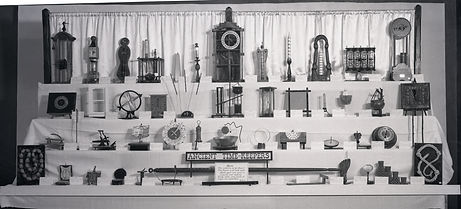
Part of the Lamberg model clock collection
But what, you’re going to ask, are two classical Greek columns, quite un-depot-like, doing at the feet of our steps? That’s more history. The Fillmore State Bank had built our first ornamental building. It was faced with Sespe brownstone from George Henley’s quarries up the Big Sespe, and had these two columns at the corner entrance. When “Bud” Rudkin remodeled in 1935, Earl Campbell bought them for a gateway to his ranch. But since they weigh about 1500 pounds each, he never got around to putting them up. His daughter, Elizabeth Campbell Thomas, gave them to the museum not long ago. We didn’t dare put them inside, for they might go through floor, so there they are, at the foot of the dock. Now we have a depot that is both unique and antique, for these columns were hand carved by George Henley’s master craftsman, just as the Greeks made them several thousand years ago.
We’re sure the Southern Pacific will never build a depot like it

Joel Schwartz in the boxcar
Is that the end of the story? No, the depot filled up fast then, when people discovered how much fun it was to turn in Great Grandma’s farthingale and Great Grandpa’s mustache cup. It looked as if we needed an annex. Back to the telephone went Dorothy Haase and I, looking for a boxcar for sale. I called as far north as Oregon and as far east as Iowa, always to run into a dead end. Then we heard about Mojave. When Bob Phillips and Fred Barger – my ever-faithful unpaid carpenter- drove up to that railroad recycling yard, we found the 1953 boxcar I had ordered, sitting, off its wheels, in the desert sand. I was indignant. Was that any way to treat my boxcar? Then looking around the bend of the track it had been on, I saw that it had just missed being shunted into an oven that would heat up to 1250 degrees.
We know that is car had been derailed, or it would never been discarded to soon. The frame was so sprung that it takes a tractor to open and close the steel sliding doors, so we had to cut a door in the side. Very few of our attendants come to work on tractors. Then it needed ventilation, air conditioning, flooring, steps and interior paint. Now it is the home of all our railroad memorabilia and other hardware.
But what, you’re going to ask, are two classical Greek columns, quite un-depot-like, doing at the feet of our steps? That’s more history. The Fillmore State Bank had built our first ornamental building. It was faced with Sespe brownstone from George Henley’s quarries up the Big Sespe, and had these two columns at the corner entrance. When “Bud” Rudkin remodeled in 1935, Earl Campbell bought them for a gateway to his ranch. But since they weigh about 1500 pounds each, he never got around to putting them up. His daughter, Elizabeth Campbell Thomas, gave them to the museum not long ago. We didn’t dare put them inside, for they might go through floor, so there they are, at the foot of the dock. Now we have a depot that is both unique and antique, for these columns were hand carved by George Henley’s master craftsman, just as the Greeks made them several thousand years ago.
We’re sure the Southern Pacific will never build a depot like it